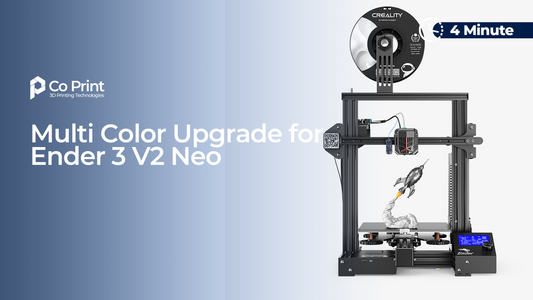
In a bed-slinger, the print bed moves back and forth on one axis while the toolhead moves on the others. In a CoreXY printer, the toolhead moves in X and Y while the bed only moves up and down. Bed-slingers are simpler and open; CoreXY machines are usually enclosed boxes. Both can print multicolor, and the right choice depends on your materials and how you work.
Most multi-toolhead printers on the market are CoreXY machines in an enclosed box. Quadro is a bed-slinger with an open frame. Here's what that means, and when each one makes sense.
How a Bed-Slinger Works
The toolhead moves along the X-axis, the bed moves along Y, and Z lifts the print as it grows. It's the layout of most desktop printers.
Strengths
- Simpler mechanics and fewer parts.
- Open access: you can see, reach and take the print off easily.
- Lower build cost, which keeps the printer affordable.
- A single X-axis suits a multi-toolhead carriage, because the heavy heads only move in one direction.
Trade-offs
- The bed and the print move, so very tall or heavy prints add inertia.
- Stiffness matters: the bed and the Z structure have to stay rigid at speed.
How CoreXY Works
The bed stays still in X and Y, and moves only in Z. The toolhead moves in both X and Y with a belt system.
Strengths
- The print stays put while the head moves, which helps with tall or heavy prints.
- Commonly built as an enclosed chamber.
Trade-offs
- More complex belt and frame mechanics.
- With several toolheads, the whole heavy carriage has to move in X and Y.
- Enclosed boxes limit access, and cost more.
What It Means for Multicolor Printing
A multicolor printer with four toolheads carries more mass on the toolhead side. On a bed-slinger, that mass only travels along X. On CoreXY it travels in both directions. Neither is wrong, but the layout changes where you put the stiffness.
On Quadro, we handled that with a single-piece aerospace-grade aluminum carriage, a dual-motor Y-axis, and 40 mm structural filament arms that brace the Z tower. See how Quadro coordinates four independent toolheads and how it makes tool changes faster.
Printing ABS and Other Temperature-Sensitive Materials
Materials like ABS shrink as they cool, so they print best in a stable, draft-free environment. That's the main reason enclosed printers exist.
An open frame prints PLA, PETG and TPU without any special setup. ABS works too, but a stable temperature around the print helps, and an enclosure is the usual way to get it. Quadro supports ABS, and an optional enclosure add-on is available for anyone who wants to print temperature-sensitive materials with a stable environment around the print.
The benefit of the open-frame-plus-add-on approach is that you choose. Leave it open for easy access with everyday materials. Add the enclosure when your material needs it.
Bed-Slinger vs CoreXY at a Glance
| Bed-slinger | CoreXY | |
|---|---|---|
| Moving parts | Bed moves in Y, head in X | Head moves in X and Y, bed in Z |
| Mechanics | Simpler | More complex |
| Access to the print | Open | Often enclosed |
| ABS and similar materials | Best with an enclosure add-on | Enclosure built in |
| Multi-toolhead carriage | Moves along one axis | Moves along two |
| Typical cost | Lower | Higher |
How to Choose
- Mostly PLA, PETG and TPU, and you value access and simplicity: an open-frame bed-slinger is a great fit.
- Often printing ABS or similar: pick a printer with an enclosure, or one that offers an enclosure add-on.
- Want a fully closed chamber out of the box: a CoreXY box is the usual route.
For the full set of questions to ask before buying any multi-toolhead printer, see our buying guide. For how the heads themselves differ, read IDEX vs IQEX.
Key Takeaways
- A bed-slinger moves the bed in one axis. CoreXY moves the head in two.
- Bed-slingers are simpler and open. CoreXY machines are usually enclosed.
- A multi-toolhead carriage only moves along X on a bed-slinger.
- Open frame works for everyday materials, and an enclosure handles ABS and similar.
Want to see an open-frame four-toolhead printer? See Quadro or visit the Kickstarter page.
3. FAQ
What is a bed-slinger 3D printer? A printer where the print bed moves back and forth on one axis, while the toolhead moves on the others. Most desktop printers use this layout.
Is CoreXY better than a bed-slinger? Not always. CoreXY keeps the bed still in X and Y, which helps with tall or heavy prints, but it is more complex and usually enclosed. A bed-slinger is simpler, more open and often more affordable.
Can an open-frame printer print ABS? Yes, though ABS prints best in a stable, draft-free environment. An enclosure helps. Quadro supports ABS, and an optional enclosure add-on is available.
Can a bed-slinger be a good multicolor printer? Yes. On a bed-slinger a multi-toolhead carriage moves only along the X-axis, and a rigid frame, dual Y motors and a braced Z tower keep the print stable.
Why are most multi-toolhead printers enclosed CoreXY? Enclosure helps with temperature-sensitive materials, and CoreXY is a popular layout for enclosed boxes. It is a design choice, and open-frame designs trade a closed chamber for access and simplicity.