




In multicolor and multi-material 3D printing, changing from one material to another usually involves more than simply switching colors.
The printer may need to retract filament, load the next material, clear the previous color from the nozzle, heat the system to the correct temperature, and only then continue printing.
Quadro approaches this process differently.
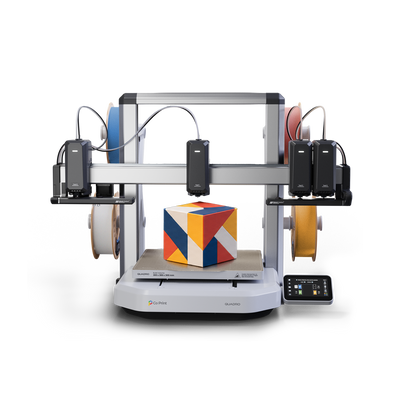
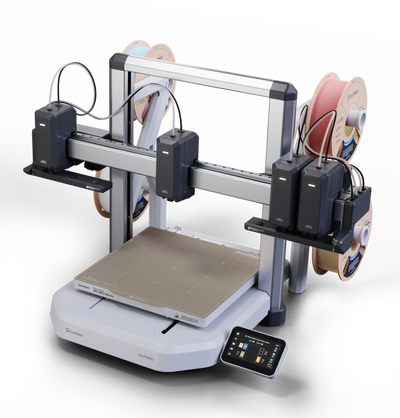
With four independent toolheads, each material can remain loaded in its own nozzle. Instead of repeatedly replacing filament inside a single hotend, Quadro can move between already prepared toolheads.
A tool change can be completed in approximately 1 seconds.
But the mechanical movement is only one part of the process.
The next toolhead also needs to be ready to print.
The Next Toolhead Can Prepare in Advance
While one toolhead is actively printing, another toolhead can remain at a lower standby temperature.
For example, an inactive toolhead may wait at approximately 140°C rather than cooling completely to room temperature.
As Quadro approaches the point where that toolhead will be needed, the nozzle can begin heating toward its required printing temperature.
In a typical example, increasing from around 140°C to approximately 220°C can take roughly 30–40 seconds.
The important part is when this happens.
The printer does not necessarily need to stop for 30–40 seconds and wait.
That heating period can take place while the current toolhead is still printing.
So while:
T0 is printing at its target temperature,
T1 can already be heating in preparation for the upcoming tool change.
By the time Quadro needs T1, much of the thermal preparation has already been completed.

Preheating happens while the active toolhead is still printing.
Mechanical Change: Approximately 1 Seconds
Once the next toolhead is ready, Quadro does not need to unload and reload filament through the same nozzle.
Each color or material already has its own toolhead and extrusion path.
The active toolhead moves toward its parking area while the next toolhead takes over the printing operation.
According to Quadro’s current architecture, this tool change can be completed in approximately 1 seconds.
This is possible because the change is primarily a movement between independent toolheads rather than a complete filament replacement process.

Why Not Keep Every Toolhead at Full Temperature?
Quadro could theoretically keep every nozzle at its full printing temperature throughout the print.
But that would not always be necessary.
Instead, inactive toolheads can remain in a standby state and only begin heating toward their target temperature as they approach their next printing operation.
This creates a balance between two extremes:
A completely cold nozzle would require more preparation time.
A nozzle kept continuously at full printing temperature may remain unnecessarily hot even when it will not be used for some time.
The standby approach keeps the toolhead closer to its operating state while still allowing temperature management between tool changes.
No Filament Reload for Every Color Change
There is another important difference.
In a single-nozzle multicolor system, a color change normally requires the current filament to leave the hotend and the next filament to enter it. Remaining material then needs to be cleared before the new color can print cleanly.
Quadro has a separate nozzle for each toolhead.
So during a normal tool change, the system does not need to repeatedly unload one color and feed another through the same extrusion path.
Instead:
Current toolhead → parks
Next prepared toolhead → becomes active
This is also why Quadro can dramatically reduce the purge waste normally associated with single-nozzle multicolor systems.
Tool Change Is More Than a 1-Second Movement
Looking only at the approximately 1-second mechanical change does not tell the whole story.
What matters is what happens before that moment.
Quadro can prepare the next toolhead while the current one is still working.
For example:
T0: Printing
T1: Heating toward its target temperature
T2: Standby
T3: Standby
When T1 is needed, it can already be close to or at its printing temperature.
This allows mechanical movement and thermal preparation to work as parts of the same process instead of forcing the printer to complete every task sequentially.

Prepared Before It Is Needed
Quadro’s tool change strategy is built around one simple principle:
Do as much preparation as possible before the change actually happens.
Instead of:
→ Stop
→ Heat
→ Change
→ Resume
Quadro can operate more like:
Prepare next toolhead
→ Tool change
→ Continue printing
With independent nozzles, controlled standby temperatures, advance heating, and an approximately 1-second mechanical tool change, the goal is to minimize the time the printer spends waiting between colors or materials.
That is what makes Quadro’s tool change process different:
The next toolhead starts getting ready before the current one has finished.