




Four independent toolheads do much more than increase the number of colors or materials a printer can use.
They require an entirely different motion architecture.
In a conventional multi-color system, multiple filaments eventually converge into the same extrusion path and the same nozzle. Quadro takes a different approach.
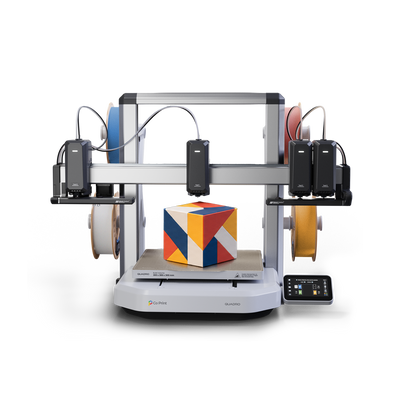
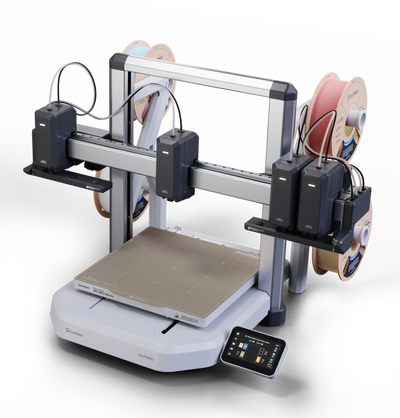
Each toolhead has its own extrusion path, its own nozzle, and its own independent X-axis drive system.
The challenge is making four separate toolheads move on the same axis without interfering with one another.
That is where Quadro’s mechanical architecture comes into play.

Four Toolheads, Four Independent Drive Systems
At first glance, Quadro’s X-axis may look like a single conventional motion system.
Inside, however, it contains four completely separate belt systems.
Four belts run across the X-axis, positioned one above another. Each belt is assigned to one toolhead and is supported by its own pulley system throughout the axis.
More importantly, each toolhead also has its own dedicated stepper motor.
This means the four toolheads do not share a common X-axis drive.
T0, T1, T2 and T3 can each be positioned independently.
Each belt also uses its own automatic tensioning mechanism, helping maintain consistent belt tension and reducing unwanted movement during acceleration and direction changes.

Coordinated Motion Beyond the X-Axis
Independent X-axis movement is only part of the system.
Tool changes need to happen quickly, otherwise the time saved through independent extrusion paths could be lost during positioning.
For this reason, Quadro's control system is designed to coordinate multiple axes simultaneously.
In addition to the four X-axis stepper motors controlling the individual toolheads, the system can coordinate them with:
- two Y-axis motors
- one Z-axis motor
This allows Quadro to calculate and execute several movements as part of the same transition.
Instead of completing every movement sequentially, the machine can coordinate the toolheads and printer axes together where the operation allows it.
Do the Toolheads Pass Through Each Other?
No.
Independent movement does not mean the four toolheads physically move through one another.
Quadro solves this using dedicated parking stations called QDocks.
There are two QDock stations positioned at opposite ends of the X-axis.
Each QDock can accommodate up to three toolheads.
The system continuously determines which toolhead needs access to the active printing area and moves the remaining toolheads out of its path.
This creates space for the active toolhead without requiring the printheads to cross through each other.

How a Tool Change Works
For example, imagine T0 is required for the next section of a print.
If T1, T2, and T3 are currently occupying positions that would restrict T0's movement, the system can move those three toolheads toward a QDock simultaneously.
T1, T2, and T3 park inside the station, clearing the active printing area.
T0 can then move freely across the required X-axis range and continue printing.
When another material or color is required, Quadro reorganizes the toolhead positions again and gives the next active toolhead access to the printing area.
The important distinction is that the system is not loading and unloading filament from one shared nozzle.
It is repositioning already-prepared, independent toolheads.
1 - Before Tool Change

2 - Parking

3 - T0 Active

Why This Architecture Matters
Keeping four complete toolheads available changes what happens during a material transition.
In a shared-nozzle system, changing materials may require the previous filament to leave the extrusion path before the next filament can fully enter it.
With Quadro, each material can remain inside its assigned toolhead.
The system's task becomes primarily mechanical:
- Move inactive toolheads away from the print area.
- Make room for the required toolhead.
- Position the active toolhead.
- Continue the print.
There is no need for the active material to replace another material inside the same extrusion path before every tool change.
This separation is one of the fundamental ideas behind Quadro.
Four Extrusion Systems, One Coordinated Machine
Quadro should not be thought of as a conventional multi-color system with additional filament inputs.
Its architecture is based around four complete extrusion systems operating inside one coordinated motion platform.
Each toolhead has:
- its own filament path
- its own extruder
- its own nozzle
- its own X-axis drive system
The QDock system manages physical toolhead availability, while Quadro's control system coordinates the motors and printer axes required to complete each transition.
The result is a system in which four mechanically independent toolheads can operate as parts of one printer.
They remain separate where separation matters, while the machine coordinates them as a single system.